
Simplifying FSMA 204 Compliance in the Mid-Supply Chain: Clarification from the FDA
Simplifying FSMA 204 Compliance in the Mid-Supply Chain: Clarification from the FDA
Simplifying FSMA 204 Compliance in the Mid-Supply Chain: Clarification from the FDA

Written By:
Caitlin Fike
Caitlin Fike

Under FSMA 204, tracking high-risk food items has introduced a significant practical challenge for mid-supply chain logistics. Upstream processors frequently assign unique production codes to distinct lots. When a shipment is packed, a single container or pallet can easily hold multiple distinct production lots.
For downstream receivers including importers, cold storage facilities, and 3PLs; manually receiving, managing, and passing forward numerous plant-level production codes for a single shipment can be operationally restrictive and administratively expensive.
The FDA’s Official Clarification
To address this friction point, Wholechain, working alongside the National Fisheries Institute (NFI) FSMA 204 Traceability Workgroup, engaged directly with the FDA’s Traceability Rule Team. The inquiry sought practical clarification regarding whether a processor could assign a single, overarching Traceability Lot Code (TLC) per product to a shipment at the time of packing.
The FDA’s Technical Assistance Network (TAN) officially reviewed the inquiry and clarified its position:
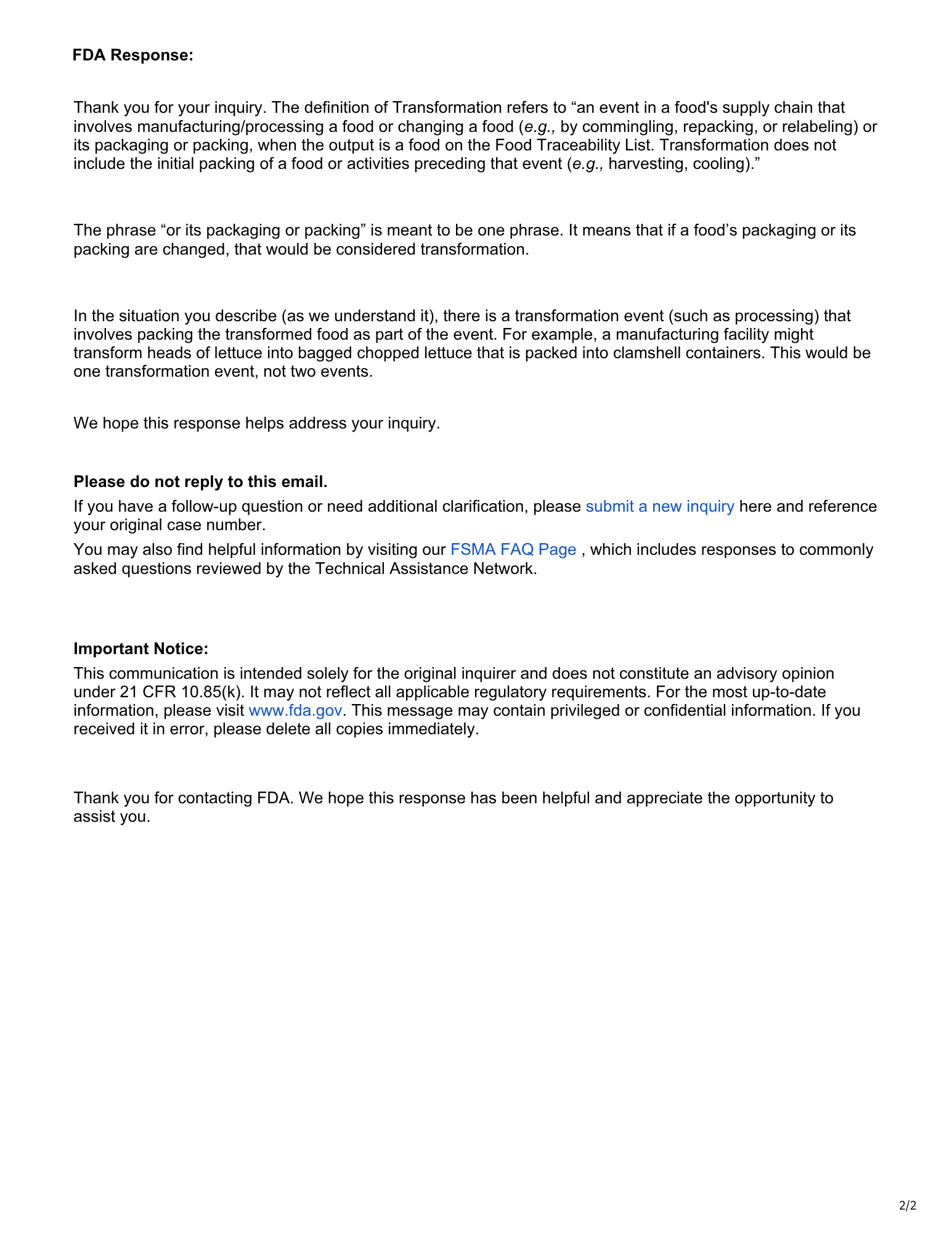
"In the situation you describe (as we understand it), there is a transformation event (such as processing) that involves packing the transformed food as part of the event. For example, a manufacturing facility might transform heads of lettuce into bagged chopped lettuce that is packed into clamshell containers. This would be one transformation event, not two events."
Furthermore, the FDA has previously provided guidance highlighting lotting flexibility:
"We have provided flexibility for how a firm identifies a traceability lot; a firm could define a lot as a case, a pallet, a day's production, or some other amount of product."
Because the Agency considers packing to be an inherent part of the transformation event, and explicitly allows flexibility in how a firm defines a lot, assigning and sharing a single TLC per product in a shipment is aligned with the final rule as written.
You can view the official FDA correspondence in full below.
 |  |
|---|
Operational Impact
While every firm is responsible for evaluating its own compliance strategy, FDA's clarification suggests clear operational advantages for supply chain participants:
For Upstream Processors: Processors have the option to link internal production codes directly to one shipment-level TLC per product in their records, helping to keep packing and shipping lines moving.
For 3PLs & Cold Storage Operators: This framework reduces the administrative and logistical need to slot multiple individual production codes into warehouse management systems and pick slots, respectively. It helps mitigate the practice of "grand lotting" (grouping distinct lots together at receipt) by allowing the receiver to handle a single TLC per product.
For Enterprise Buyers: Receiving organizations can ingest clean, unified data that can be linked directly to their own internal lot codes upon receipt.
For Traceability Investigations: The integrity of the TLC and TLC source is maintained. Because the shipment-level TLC links back to the original source location, investigators can still bypass intermediary logistics nodes to get straight to the source during an investigation.
Standard-based Interoperability (EPCIS)
This framework is highly compatible with global data standards. Traceability platforms utilizing GS1 standards with EPCIS-compliant data structures can map internal operational identifiers (like local inventory lot numbers) to the compliance-required TLC and TLC Source on the backend. Because the FDA’s own Product Tracing System (PTS) utilizes the electronic EPCIS format, choosing standardized data sharing allows supply chain partners to maintain seamless operational tracking while fully satisfying the rule's data-integrity requirements.
For a technical overview of how to structure these data events within your own tracking systems, you can review our FSMA 204 Integration Blueprint.
Regulatory & Liability Disclaimer
Wholechain is a technology solution provider. This document is for informational and educational purposes only and does not constitute legal or regulatory compliance advice. While technology facilitates the mapping, management, and sharing of event-based traceability data, each individual supply chain participant remains solely responsible for evaluating and ensuring its own compliance with FSMA 204 and all other applicable state, federal, or international food safety regulations.
Under FSMA 204, tracking high-risk food items has introduced a significant practical challenge for mid-supply chain logistics. Upstream processors frequently assign unique production codes to distinct lots. When a shipment is packed, a single container or pallet can easily hold multiple distinct production lots.
For downstream receivers including importers, cold storage facilities, and 3PLs; manually receiving, managing, and passing forward numerous plant-level production codes for a single shipment can be operationally restrictive and administratively expensive.
The FDA’s Official Clarification
To address this friction point, Wholechain, working alongside the National Fisheries Institute (NFI) FSMA 204 Traceability Workgroup, engaged directly with the FDA’s Traceability Rule Team. The inquiry sought practical clarification regarding whether a processor could assign a single, overarching Traceability Lot Code (TLC) per product to a shipment at the time of packing.
The FDA’s Technical Assistance Network (TAN) officially reviewed the inquiry and clarified its position:
"In the situation you describe (as we understand it), there is a transformation event (such as processing) that involves packing the transformed food as part of the event. For example, a manufacturing facility might transform heads of lettuce into bagged chopped lettuce that is packed into clamshell containers. This would be one transformation event, not two events."
Furthermore, the FDA has previously provided guidance highlighting lotting flexibility:
"We have provided flexibility for how a firm identifies a traceability lot; a firm could define a lot as a case, a pallet, a day's production, or some other amount of product."
Because the Agency considers packing to be an inherent part of the transformation event, and explicitly allows flexibility in how a firm defines a lot, assigning and sharing a single TLC per product in a shipment is aligned with the final rule as written.
You can view the official FDA correspondence in full below.
| |
|---|
Operational Impact
While every firm is responsible for evaluating its own compliance strategy, FDA's clarification suggests clear operational advantages for supply chain participants:
For Upstream Processors: Processors have the option to link internal production codes directly to one shipment-level TLC per product in their records, helping to keep packing and shipping lines moving.
For 3PLs & Cold Storage Operators: This framework reduces the administrative and logistical need to slot multiple individual production codes into warehouse management systems and pick slots, respectively. It helps mitigate the practice of "grand lotting" (grouping distinct lots together at receipt) by allowing the receiver to handle a single TLC per product.
For Enterprise Buyers: Receiving organizations can ingest clean, unified data that can be linked directly to their own internal lot codes upon receipt.
For Traceability Investigations: The integrity of the TLC and TLC source is maintained. Because the shipment-level TLC links back to the original source location, investigators can still bypass intermediary logistics nodes to get straight to the source during an investigation.
Standard-based Interoperability (EPCIS)
This framework is highly compatible with global data standards. Traceability platforms utilizing GS1 standards with EPCIS-compliant data structures can map internal operational identifiers (like local inventory lot numbers) to the compliance-required TLC and TLC Source on the backend. Because the FDA’s own Product Tracing System (PTS) utilizes the electronic EPCIS format, choosing standardized data sharing allows supply chain partners to maintain seamless operational tracking while fully satisfying the rule's data-integrity requirements.
For a technical overview of how to structure these data events within your own tracking systems, you can review our FSMA 204 Integration Blueprint.
Regulatory & Liability Disclaimer
Wholechain is a technology solution provider. This document is for informational and educational purposes only and does not constitute legal or regulatory compliance advice. While technology facilitates the mapping, management, and sharing of event-based traceability data, each individual supply chain participant remains solely responsible for evaluating and ensuring its own compliance with FSMA 204 and all other applicable state, federal, or international food safety regulations.
Under FSMA 204, tracking high-risk food items has introduced a significant practical challenge for mid-supply chain logistics. Upstream processors frequently assign unique production codes to distinct lots. When a shipment is packed, a single container or pallet can easily hold multiple distinct production lots.
For downstream receivers including importers, cold storage facilities, and 3PLs; manually receiving, managing, and passing forward numerous plant-level production codes for a single shipment can be operationally restrictive and administratively expensive.
The FDA’s Official Clarification
To address this friction point, Wholechain, working alongside the National Fisheries Institute (NFI) FSMA 204 Traceability Workgroup, engaged directly with the FDA’s Traceability Rule Team. The inquiry sought practical clarification regarding whether a processor could assign a single, overarching Traceability Lot Code (TLC) per product to a shipment at the time of packing.
The FDA’s Technical Assistance Network (TAN) officially reviewed the inquiry and clarified its position:
"In the situation you describe (as we understand it), there is a transformation event (such as processing) that involves packing the transformed food as part of the event. For example, a manufacturing facility might transform heads of lettuce into bagged chopped lettuce that is packed into clamshell containers. This would be one transformation event, not two events."
Furthermore, the FDA has previously provided guidance highlighting lotting flexibility:
"We have provided flexibility for how a firm identifies a traceability lot; a firm could define a lot as a case, a pallet, a day's production, or some other amount of product."
Because the Agency considers packing to be an inherent part of the transformation event, and explicitly allows flexibility in how a firm defines a lot, assigning and sharing a single TLC per product in a shipment is aligned with the final rule as written.
You can view the official FDA correspondence in full below.
| |
|---|
Operational Impact
While every firm is responsible for evaluating its own compliance strategy, FDA's clarification suggests clear operational advantages for supply chain participants:
For Upstream Processors: Processors have the option to link internal production codes directly to one shipment-level TLC per product in their records, helping to keep packing and shipping lines moving.
For 3PLs & Cold Storage Operators: This framework reduces the administrative and logistical need to slot multiple individual production codes into warehouse management systems and pick slots, respectively. It helps mitigate the practice of "grand lotting" (grouping distinct lots together at receipt) by allowing the receiver to handle a single TLC per product.
For Enterprise Buyers: Receiving organizations can ingest clean, unified data that can be linked directly to their own internal lot codes upon receipt.
For Traceability Investigations: The integrity of the TLC and TLC source is maintained. Because the shipment-level TLC links back to the original source location, investigators can still bypass intermediary logistics nodes to get straight to the source during an investigation.
Standard-based Interoperability (EPCIS)
This framework is highly compatible with global data standards. Traceability platforms utilizing GS1 standards with EPCIS-compliant data structures can map internal operational identifiers (like local inventory lot numbers) to the compliance-required TLC and TLC Source on the backend. Because the FDA’s own Product Tracing System (PTS) utilizes the electronic EPCIS format, choosing standardized data sharing allows supply chain partners to maintain seamless operational tracking while fully satisfying the rule's data-integrity requirements.
For a technical overview of how to structure these data events within your own tracking systems, you can review our FSMA 204 Integration Blueprint.
Regulatory & Liability Disclaimer
Wholechain is a technology solution provider. This document is for informational and educational purposes only and does not constitute legal or regulatory compliance advice. While technology facilitates the mapping, management, and sharing of event-based traceability data, each individual supply chain participant remains solely responsible for evaluating and ensuring its own compliance with FSMA 204 and all other applicable state, federal, or international food safety regulations.
Caitlin Fike
Want to get started on traceability?
Want to get started on traceability?
Want to get started on traceability?
Explore how traceability works and take your first step in getting started,
simply click the link below.
Explore how traceability works and take your first step in getting started,
simply click the link below.